The English Versatility is a class introduced by APHA influential members of the English division. It is being offered as a pilot class at several AQHA events in 2025. All rule references refer to the APHA rule book.
- Hunt Seat Attire and Tack: See rule SC-195 & SC-200.
- The purpose of this class is to demonstrate the versatility of the English versatility horse. The horse should reflect the versatility, attitude, and movement of a versatile English horse. The horse should be well-trained, relaxed, quiet, soft and cadenced at all gaits. The ideal English versatility horse will travel with forward movement and demonstrate an obvious lengthening of stride at extended gaits. The horse will be ridden on light contact without requiring undue restraint. The overall manners and responsiveness of the English versatility horse to make timely transitions in a smooth and correct manner, as well as the quality of the movement and maneuvers are of primary considerations. Movement, expression, and attitude are of utmost importance.
- English Versatility horses should exhibit a good attitude and a natural demeanor. Emphasis should be placed on their manner, movement, and attitude, as indicated by the horse’s ears, mouth, tail, and overall way of going. Judges shall be instructed to pay particular attention to the above-mentioned and any attempt to alter the above shall result in lower maneuver evaluations.
- Gaits will be judged according to SC-201. English Performance Gaits emphasizing correctness, quality and degree of difficulty. Expression, rhythm, and flow are of utmost importance. Cantering with enough forward motion to approach a fence will be credit earning.
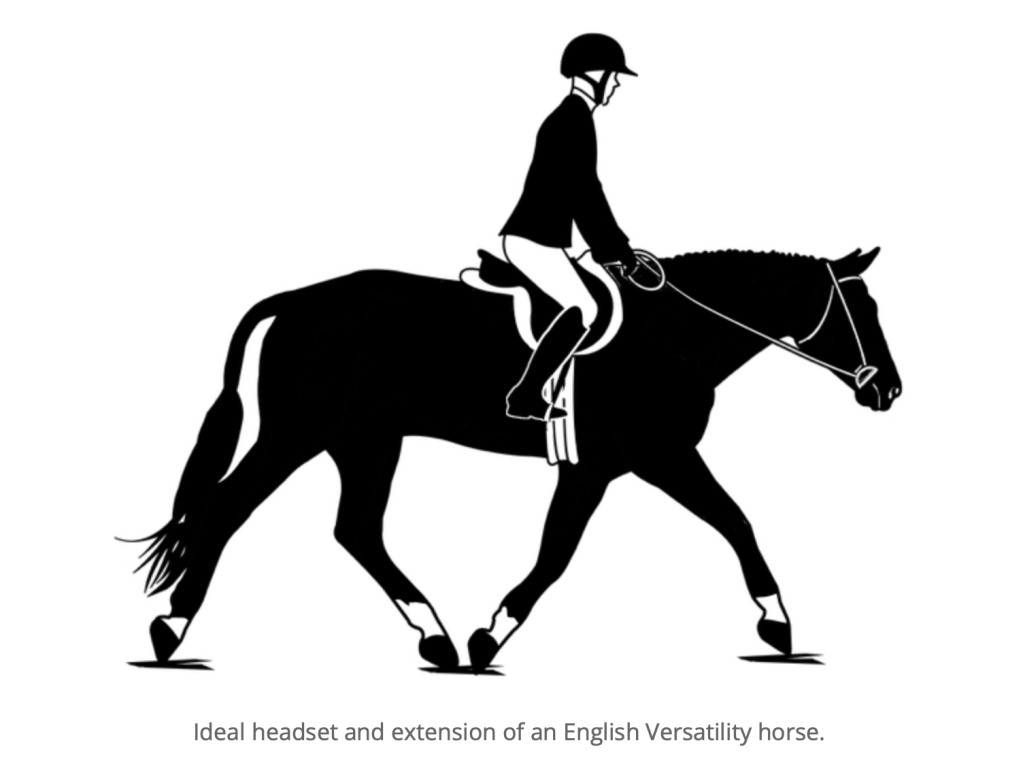
- Head Set: The head should be carried at an angle that is natural and suitable to the horse’s conformation at all gaits. Ideally, a horse should carry its head no lower than level and its nose should be in front of vertical. Below is an example of the ideal head set.
CLASS REQUIREMENTS
- Each horse will work individually, performing both required and optional maneuvers. Horses will perform a ground covering walk, trot at a pace capable of negotiating poles, and canter in a forward motion as in performing a flying lead change or approaching a fence.
- The required maneuvers will include the walk, trot, and canter in both directions; extended trot, stop, back, 180 forehand turn either direction, change of lead (simple or flying) either direction, leg yield, and trot or canter over a jump, cross rail, cavelettis, ground poles or raised rails. Maximum height of 2’6” on any jump or 12” on any raised rails. Amateur and youth division to be limited to raised rails.
- Pole Distances:
- Walk poles: 30”
- Trot poles: 3’6”-4’
- Canter poles: 8’-10’
- Optional maneuvers may include extending the walk, extending the trot, hand gallop, stand quietly, trot through or around cones or chute, or some reasonable combination of maneuvers that would be expected of an English versatility horse to perform.
- Patterns will consist of 10 to 15 maneuvers.
- The maneuvers may be arranged in various combinations with final approval by the judge.
- One of the suggested five patterns may be used, however a judge may utilize a different pattern as long as all required maneuvers and three or more optional maneuvers are included.
- No time limit.
SCORING:
Scores will be between 0-100 points and automatically begins the run with a score of 70 points. The horse/rider team is score on the quality of each maneuver (e.g. -1 ½ extremely poor, -1 very poor, -+1/2 poor, 0 correct, +1/2 good, +1 very good, +1 ½ excellent). Maneuver evaluations and penalty applications are to be determined independently. The following penalties will be applied to each occurrence and to deducted from the final score:
One-half point
- Each tick of log, pole, cone, plant or obstacle
One-point penalties
- Over-bridled (per maneuver)
- Out of frame (per maneuver)
- Break of gait at walk or trot for 2 strides or less
- Wrong lead or out of lead for 2 strides or less
- Each hit, bite or stepping on a log, pole, cone, plant or any component of the obstacle.
- Both front or hind feet in a single-strided slot or space at a walk or trot
- Skipping over or failing to step into required space
- Split pole in cantering over poles
- Failure to meet the correct strides on trot-over and canter over pole obstacles
- Loss of forward motion during transitions
- Quick, short vertical strides (per maneuver)
Three-point penalties
- Break of gait at walk or trot for more than two strides
- Break of gait at canter, except when correcting an incorrect lead
- Wrong lead or out of lead for more than 2 strides
- Knocking down an elevated pole, cone, barrel, plant, standard, obstacle or severely disturbing an obstacle
- Out of lead or cross-cantering more than two strides when changing leads, trotting more than three strides when making a simple lead change,
- Trotting three or more strides in a canter departure from a stop or walk.
- Over canted at the canter—(Outside hind leg consistently carried further in than inside front leg) per maneuver
- Stepping outside the confines of, falling or jumping off of an obstacle with designated boundaries with one foot once the foot has entered obstacle, including missing one element of an obstacle on a line of travel with one foot.
- Loss of cadence at any gait per maneuver
- Overflexing or straining neck in head carriage so the nose is carried behind the vertical per maneuver
- Opening mouth excessively per maneuver
- A back that is poor, reluctant or with hesitation
- Excessive nosing out per maneuver
- Excessive movement of the topline at the trot or canter per maneuver
- Head Carried too low (tip of ear consistently below the withers)
- Head Carried too high (tip of ear consistently above the withers)
- Excessive slowness at any gait, loss of forward momentum
Five-point penalties
- Blatant disobedience (kick, bite, buck, rear, etc)
- Each refusal of a maneuver or obstacle
- Use of either hand to instill fear or praise
- Spurring in front of the girth
- Stepping outside the confines of, falling or jumping off or out of an obstacle with designated boundaries with more than one foot once the foot has entered obstacle, including missing one element of an obstacle on a line of travel with more than one foot.
- A horse which appears sullen, dull, lethargic, intimidated, emaciated, drawn or overly tired
- Knocking down a jump, cross rail or cavelletti.
DISQUALIFICATIONS
- Eliminate or adding maneuver
- Incomplete maneuver
- Breaking pattern
- Repeated blatant disobedience
- Third cumulative refusal, balk, or evading an obstacle by shying or backing over entire course
- Failure to ever demonstrate correct lead and/or gait as designated
- Failure to complete obstacle
- Fall of horse or exhibitor
- Excessive schooling, pulling, turning, or backing anywhere on course
- No attempt to perform an obstacle
- Equipment failure that delays completion of pattern
- Excessively or repeated touching the horse on the neck to lower the head
- Failure to enter, exit or work obstacle in any manner other than how it’s described, including overturns of more than ¼ turn
- Failure to follow the correct line of travel between obstacles.
- Illegal equipment
- Willful abuse
- Lameness
- Unsportsmanlike conduct
 Routt County Fair Open Horse Show